Gorilla Trekking in Rwanda: Highlights Guiding A Once In A Life Time Experience

If you’re considering gorilla trekking in Rwanda then you’ve probably wondered what it actually feels like. Not the logistics or the accommodation, but the moment itself. Standing toe to toe with a wild gorilla.
There are no words that do it justice, but the following tells the story of the first 24 hours in Rwanda on a recent privately guided safari.

Rwanda: November, 2025
Nestled amongst a gaggle of 40 foot bamboo trees our group has just had our final safety briefing. Above us an invisible sky sprinkles rain drops on the canopy, with only the most intrepid making its way down to the forest floor, welcomed by an eager sea of ferns.
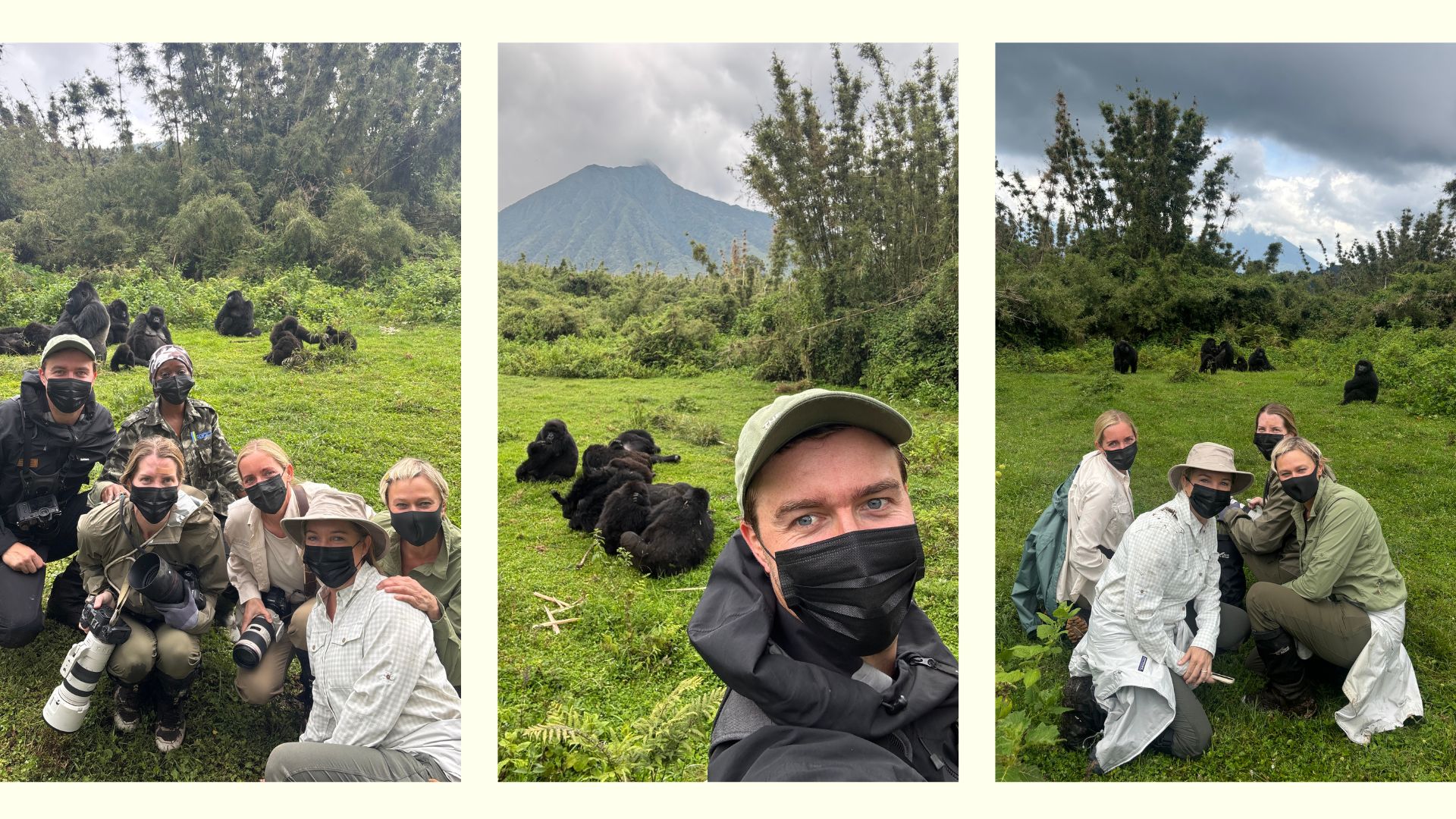
Ahead of us waits the silverback gorilla, Humura, and his new family - a recently formed coalition that splintered from the Igisha family earlier this year. The unit is so fresh that trackers and guides are still establishing its exact make up, but it is believed Humura moved with 23 other members, leaving Igisha with only 14. As fighting over the family is still ongoing, exact numbers are hard to conclusively determine.
I am leading a group of four wonderful women from Texas, none of whom have seen a wild gorilla before and who barely blink at the news that the animals we are about to see are mid-way through the gorilla equivalent of a Montague versus Capulet family feud.
That, as they say, is nature.

The Journey In
We arrived in Rwanda just 24 hours ago, navigating a host of travel disruptions that seem a constant in this day and age (election violence in Tanzania and two global conflicts in the last 12 months have really tested my international travel logistics). Even when we thought we had finally made it to Rwanda our flight was turned around due to poor visibility as we came in to land at Rwanda’s capital, Kigali so we returned to Kenya for a quick coffee in the airport before successfully attempting the journey back again.
All this had been immediately forgotten as we arrived at Singita’s private Kataza House the previous evening though.

Attached, although entirely self-run, to Singita’s world renowned Kwitonda Lodge, this four bedroom home takes the gorilla trekking experience up a notch. Every suite looks out towards three of Rwanda’s volcanoes, Sabyinyo, Gahinga and Mahvura, with forest buffalo and, if you’re lucky, forest elephant roaming the open grassland between the house and the volcanoes.
On top of this Kataza has a gym and cinema room, stunning open living room and a veranda with a heated plunge pool. If this isn’t enough the kitchen comes with a beautiful walk in wine cellar and there’s a private spa on site. Singita had scored a major home run with my guests.

The Trek Begins
Just as Kataza erased all thoughts of delayed flights, the trek would quickly do the same to the house.
Gone were memories of roll top baths and cozy fireplaces, replaced by the methodical plod of our walking boots and slightly muffled heavy breathing as we all tried to pretend we weren’t out of breath already. A pretense that usually lasts about fifteen minutes when trekking at altitude.

Trekking mountain gorillas in Rwanda, as with Uganda, begins through community land. We follow well-trodden paths through smallholdings and farms, Jodie, our Rwandan guide, pointing out the different crops and flowers while keeping an eye out for tree chameleons hidden amongst the thorny bushes marking farm boundaries.
After about an hour we reach a moat, roughly two metres deep and the same across, with a low brick wall beyond. The forest climbs from there towards the volcanoes above.
“This,” Jodie explains, “is the park boundary. Created more to keep animals in than people out. Beyond here are the gorillas."

Into the Bamboo
As it’s November, many of the gorilla families have come down the volcanoes in search of fresh bamboo. It’s shoot season, and these are a gorilla’s favourite food.
Bamboo in Rwanda typically grows between 2,500 and 3,000 metres, the lower end of a mountain gorilla’s habitat range, which quietly works in our favour. Less climbing, less time, better chance of finding them sooner when they are more active.

Ahead of us the trackers are already working, having marked the nesting site from the previous evening and returning at dawn to pick up the trail. Jodie stays in constant radio contact, guiding us towards them.
Perhaps it’s the excitement, perhaps its the altitude but conversation amongst the group seems to have lulled and everyone’s staring up at the canopy or down at the ground, shifting their weight on their wooden walking sticks, trying to visualise what that moment will be like when they first see a wild mountain gorilla.
The Call
The radio crackles and in Kinyarwanda (a language resembling French and Swahili that I can barely decipher) a message comes through.
Jodie smiles. The porters exchange glances. The rest of us look at each other for confirmation. They’re close.
We move forward, weaving nose to tail through bamboo until we reach a small clearing.
“Leave your bags here. Cameras only from this point.”
Lens caps come off. Water bottles are finished. Face masks go on. Final safety briefing delivered. Including, crucially, the vocalisation we must use to show we are not a threat.
A quick exhale followed by a low hum.
Friend, not foe.

The First Gorilla
To say the gorillas are close is a little misleading. We still have a fair amount of bamboo to work through, often pausing while a tracker clears a path ahead, but eventually we reach an open patch of forest and excitedly gaze around the clearing.
Jodie - who reached the clearing long before the rest of us amateurs - excitedly points out a gorilla on the far side of the clearing. It reaches up and pulls a gaggle of branches and leaves towards its mouth and chews, back turned to us, totally disinterested.

That we can approach these animals at all is thanks to years of habituation by the tracking team and researchers, but it is not a proximity you can ever take for granted. We slowly follow Jodie across the clearing and find that the gorilla is not alone, she has an infant with her.
Often the most active of the family the infant attempts to copy its mum and repeats her behaviour, reaching above it to some falling ivy and attempting to pull it down to the floor. Except the ivy does not budge, and the baby, reaching higher still pulls himself off the ground and hangs there like Spiderman on his first day of super hero school, unsure whether to let go and save face or keep trying to pull. Eight tourists laugh at him, but undeterred he shakes a few more times until the ivy dislodges and he hits the ground with a little bump, dignity mostly in tact. He doesn’t even eat it, he’s too young and is only suckling at the moment.

The Silverback
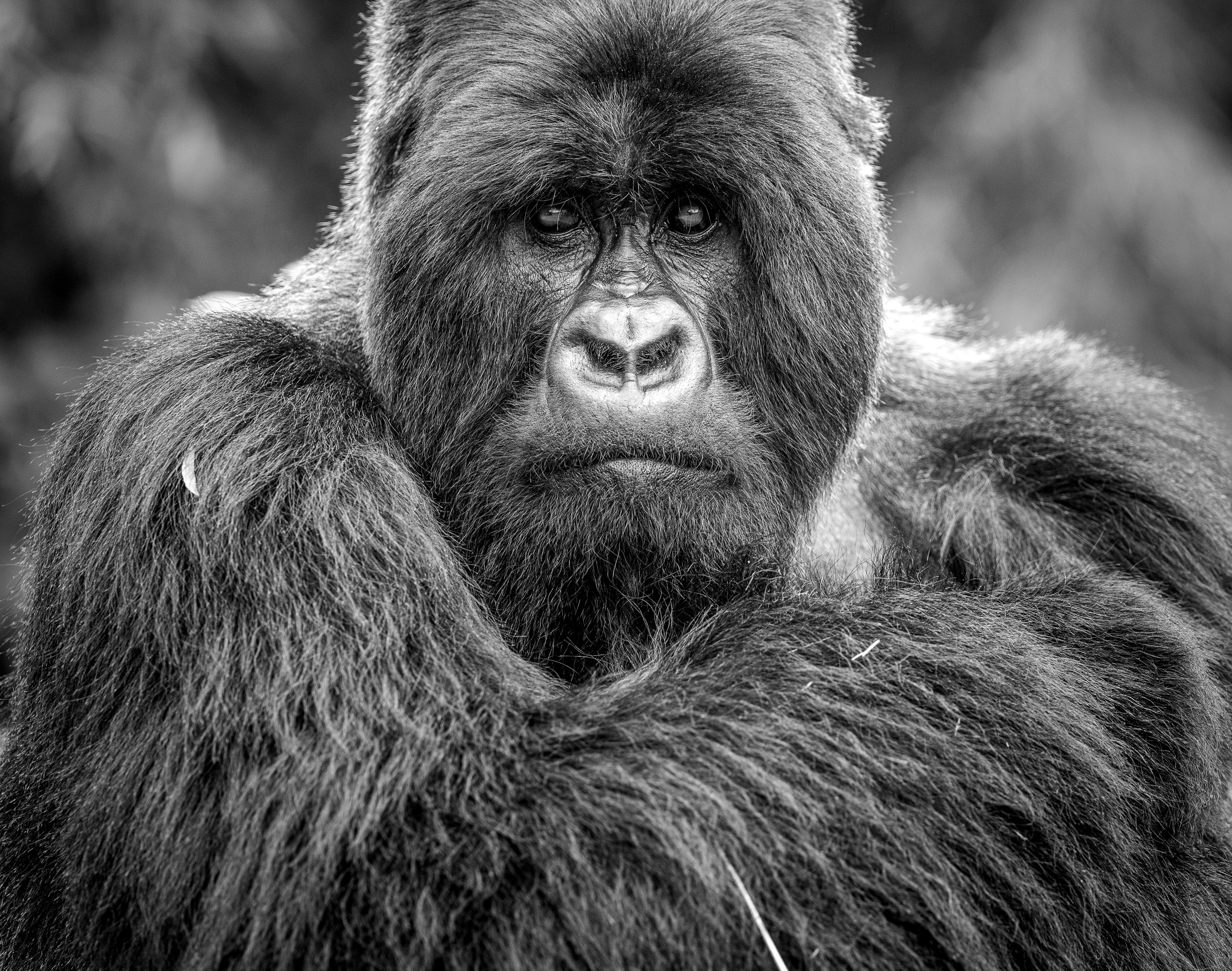
We leave Tarzan to it and move on in search of Humara, the silverback that leads the family. Much like seeing lions on safari the babies are cute but everyone wants to see the boss. We find him amongst a sea of females, chewing on bamboo, the scars of his recent fights clear to see. Much like the female he shows limited interest in us - while for my group it’s their first silverback, for him it’s his thousandth tourist. This disinterest is fine with us, all we want to do is watch in awe as he chews on the bamboo, his behaviour so familiar in its movements, so akin to our own habits and behaviour.

The bamboo has its perks in cutting down trekking time but it can make visibility a challenge, so we focus on family members away from the bamboo and quickly realise that no matter how much you try to stick to the 10 meter viewing rule the gorillas are totally unaware of it, and often walk past us within touching distance, mothers carrying infants on their backs or juveniles hopping around acting larger than there size belies.

The Fastest Hour Glass
Today the family are on the move, so we must follow, often having to hack through bamboo or huge swathes of fern but as we find each new gorilla they happily continue to feed on fresh shoots to the steady whir of our cameras, and we just take it all in.
Within what feels like minutes our hour is almost up and Jodie issues a 10 minute warning, “take your final photos and prepare to head back to the porters.”
None of us can believe how fast the hour has gone and just sit, taking in the final moments with these incredible animals. We still have two days of trekking to come but that call to get ready to leave still hurts, we could all have stayed for hours.

The Return Journey
As we begin the descent, heading back towards Kataza House, a quiet settles over the group. Then slowly, conversations begin.
“Did you see when…”
“I couldn’t believe they could…”
“I never realised…”
Stories shared between people who, just a few days earlier, were strangers. I walk behind in silence, listening, smiling, remembering just why I love this job so much.
Begin Your Rwanda Adventure
I run a small number of photography focused safaris each year, and also design private trips for people who’d prefer something built entirely around them.
You can explore both here:
Photography focused safaris: Mountain Gorillas of Rwanda, October 2027
Bespoke safaris: Plan a Private Safari
Gorilla Trekking in Rwanda: Quick Facts
• Trek Duration: Typically 1 to 4 hours depending on the family and time of year
• Trek Cost: $1,500 per person, per trek
• Difficulty: Moderate to tough, with high altitudes and uneven terrain affecting trekking difficulty
• Viewing Distance: 10m rule typically enforced. Although often broken by the gorillas.
• Time With Gorillas: Strictly one hour
• Best Time to Visit: June through October, and December to February offer drier conditions. March, and November for more atmospheric conditions and fewer people, April and May are typically the wettest months and trekking is at its toughest.